
A common complaint about Overwatch's Skill Rating (SR) system is the seemingly arbitrary way it assigns SR gains and losses. The lack of transparency over how personal performance is measured is a cause of constant angst on the official Overwatch forums due to differing gains amongst team mates in the same match.

Blizzard has stated that it will not release how SR is calculated due to the potential for abuse. However, sites like MasterOverwatch offer interesting macro views of competitive player data that can give a good idea of why you might be gaining the SR you are in games.

In our post on how competitive ranking works in Overwatch, we cover the major factors that go into calculating your SR gain after a match:

1) Win/Loss
2) Individual Performance
3) Streaks

The first thing that decides whether you gain or lose SR is whether your team won or lost the match. Where SR gains diverge within the team is when it considers your personal performance, and whether you personally were on a winning or losing streak.

How You Are Measured

Start by throwing out the idea that medals mean something to the system. Getting medals in Overwatch is purely cosmetic, and serve little purpose other than to indicate how you did relative to your team mates.

But that's not how your SR is calculated. The system calculates your SR based on your performance on the character you played compared to the global average for the character on the same map, in your ranking tier. 

So let's say you're a Platinum rank player and you play Genji on Gibraltar. You get 40 eliminations, deflect 700 damage a minute and get 2.5 dragonblade kills per minute, with a K/D of 4. That number is compared against the global average for other Platinum rank Genjis playing on Gibraltar. Since this performance is more typical of a player at Master rank, the game will reward you with higher SR than normal. If you lose the game despite that performance, the game will minimize your SR loss.

Setting Your Performance Goals

So how would you know what metrics you'll have to track and what are the numbers you'll need to surpass to optimize your SR gain? Again, use the data on MasterOverwatch.

Start by checking the percentile at which your rank belongs. 


Mouse over the percentile number and the site will tell you that you are "Top X %", where X is the percentage of players who are better than you.

What this number means is that when you play competitive, your performance will need to be such that the metrics for your character approximate those of players in the same percentile.

The metrics for each character are unique to the hero. In addition to traditional metrics like eliminations and healing, characters like Lucio will be scored on Offensive and Defensive Assists. Reinhardt players will be scored on Fire Strike, Earthshatter and Charge kills.

Below is a screenshot of a Gold Reinhardt player's stats. This player has been receiving 40 to 50 SR a match for non-streak wins and less than 20 SR for losses:
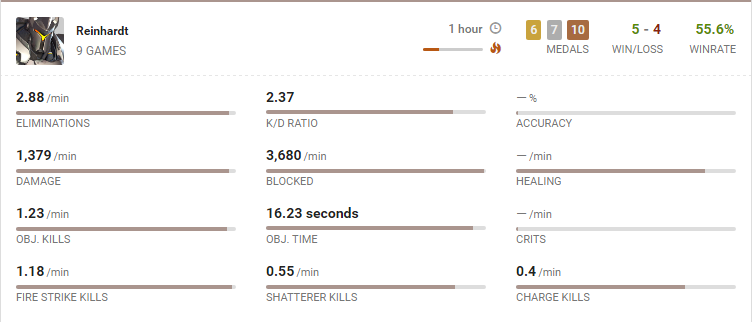

Mouse over each metric to check where you stand on it percentile-wise:


As you can see, the Reinhardt player has made enough Fire Strike kills a match to put them in the top two per cent of players for the ability use. Combined with their top 10 per cent performance on Eliminations, K/D, Block, Earthshatter and Charge kills, this probably signaled to the game that the player may belong at a higher skill level, and their SR is adjusted accordingly.

As long as your character's metrics are at a percentile that is similar to your rank percentile, you are likely to gain the "average" of 20 to 30 SR a match. A better performance will see you gain 40 to 50 SR on a non-streak win.

If you are trying to reach the next rank tier, set a performance goal based on the metrics that players at that tier are expected to average. For example, if you would like to rank up to Platinum try to aim to be top 40 per cent on all your stats. You may need to find a few examples of players at that level to get a sense of how they are performing, then try to match that.

For a quick reference, here are some stats for games in which I gained a lot of SR, normal SR and lost a lot of SR:

Average stats per game for Platinum tier Lucio players:

Eliminations: 17
K/D: 1.96
Objective Time: 11.44 seconds/min (approx 02:56 in a 15 minute match)
Healing/min: 1142
Damage Done: 5210
Offensive Assists: 3
Defensive Assists: 15
Sound Barriers: 19

Stats for a match in which I gained 78 SR as Lucio:

Eliminations: 18
K/D: 2.25
Objective Time: 4:12
Healing/min: 1028
Damage Done: 4838
Offensive Assists: 5
Defensive Assists: 26
Sound Barriers: 37

Stats for a match in which I gained 27 SR as Lucio:

Eliminations: 18
K/D: 1.29
Objective Time: 02:04
Healing/min: 1023
Damage Done: 5692
Offensive Assists: 2
Defensive Assists: 27
Sound Barriers: 31

Stats for a match in which I lost 40 SR as Lucio:

Eliminations: 4
K/D: 0.36
Objective Time: 01:19
Healing/min: 790
Damage Done: 3646
Offensive Assists: 0
Defensive Assists: 4
Sound Barriers: 12

As you can see, the pattern is such that any time my performance registered as above average, the game rewards me with more SR. If I lost with very bad stats, I lost a lot of SR.

Trying to achieve the right stats doesn't always mean you're doing what's best for the team. However, if you can improve on your play so you can achieve those stats while helping your team to victory, you should be in good standing to climb the competitive ranks in Overwatch.

In Overwatch, Elo Hell is a term frequently used to describe lower tiers of play, mostly up to the Gold tier. From Season 2's Skill Rating (SR) distribution, Gold tier appears to be the equivalent of Season 1's rank 40 to 29.

Elo Hell appears to exist at different levels, depending on the player. Former rank Diamonds will call Platinum tier Elo Hell. Former Platinums believe all is lost once they've dropped to Gold. And the pattern continues.

Whether it exists or not, here are six common characteristics of players who believe they belong in Elo Hell.


Personal Analysis posts critique my own replays to identify areas for improvement, while hopefully sharing learning points for fellow average players. 

If you see something you'd like to add or would like to share your own videos for future blog posts, please do so in the comments!

A long maintenance last night to patch in fixes brought with it some interesting changes. According to the patch notes, several bugs have been fixed which hints at issues with the ranking system, especially for Junkrat players.


Fixed several issues causing some players obtain a skill rating that's higher than their actual rating

Note: A very small number of people were affected by these issues, but those who were affected will have their skill rating adjusted appropriately

During PTR testing for Season 2, changes were made to the formulas that governed skill rating calculations. This change was implemented because a number of players were found to have placed too high during placements.

The change had only been in place two days before Season 2 suddenly went live early on September 1. Did the unfixed formula go live? How will the adjustment take place? If the PTR was any indication, players affected will start seeing major skill rating drops while gaining only 2 SR per win, which may pose a bit of a shock to the system.

The more concerning issue is whether a promised fix to support ranking had been implemented, and whether supports are still ranking lower than their DPS/Tank counterparts. A post confirming that Lucio and Mercy had been placing too low was made by Jeff Kaplan, with a fix promised as "in flight". However, no mention has been made of this fix in recent patch notes.

The fact that there was still an issue with ranking is not reassuring for early Season 2 players, supports in particular. Anecdotal posts on the forums suggest that supports are still receiving less SR than other roles.

Fixed a bug preventing Junkrat’s RIP-Tire from receiving credit for kills, achievements, and other stats

This is a cause for concern among Junkrat players, especially considering his popularity at the Silver and Gold tiers. 

Individual performance in Overwatch is derived from your score/min in a game. Junkrat's ultimate is one of the most common ways for him to get a large amount of score in a short time. For example, if his tire performs a team kill on the point, he not only misses out on +600 score for eliminations, he loses score for killing on the objective. 

In the same post about supports ranking too low, Junkrat was listed as another example of a hero that had been placing lower than others. If this was due to the bug which has just been fixed, players who've used Junkrat in Competitive play or placements may well have placed too low or not received the SR they should have.

We've previously suggested waiting until later in Season 2 to place. The Season is approaching its 2 week mark, and it may be prudent to wait one more week — especially support players — to see if any new issues surface.

Note: This post explores how Lucio may maximise his rank gain in Overwatch through earning in-game score. As Blizzard will not reveal how exactly the game measures individual performance due to potential for abuse, conclusions drawn in this post are educated guesses based on available data.

This post will be updated as new information becomes available over time.

Lucio is quite possibly one of the most misunderstood supports in Overwatch. The ease with which most players can pick up and use him at a basic level has led to a perception that the Brazilian DJ is a low-skill cap healbot.

The truth is, if you play Lucio and only stay on healing boost the entire time, you are only using part of his kit. This means you aren't generating as much score as you could be. Generate less score than the global average for your character, and the system will punish your skill rating accordingly.

For more information on score and why it matters, take a look at our guide to score in competitive Overwatch.

In addition to receiving score for general actions that contribute toward capturing objectives, Lucio has his own unique ways to rack up performance numbers. We'll cover the known ones in this post.

Healing


Lucio receives score based on the amount of life healed. If there are injured team mates near him, the score is based on the total amount of HP healed for the entire team.

The key to maximising healing score is to wait until several team mates have taken damage before switching to healing or better, using his 'E' ability to boost healing. Typically,you get +1 to +20 per second,  while amping it up boosts it to about +15 to 45, depending on the number of team mates healed and amount healed,

To find out if you performed above average for your tier on healing, check your healing/min stat on MasterOverwatch after the match.


Speed Boost 

Lucio receives +10 Assist score for each opponent killed while the team is under the effect of his speed boost aura. He receives this score even if he does not damage the opponent.

Offensive Assist


Lucio receives extra Offensive Assist score whenever team mates begin killing an opponent while under the effect of an amped speed boost. The extra score received is based on the damage done to the opponent by your team mates.

Getting Offensive Assist score does not require the opponent to die in the three seconds that the amp is active. You get offensive assist score as long as your team mates are already in the process of taking the opponent down during the amp.

In the screenshot above, the Assist +10 score is awarded for having normal speed boost on during the kill. Lucio gets an extra +20 for the damage his team mates did to the downed opponent while under the effect of amped speed boost. Finally, he also gets score for directly contributing to the elimination of Dva's Mech.

Offensive Assist may be one of the metrics for Lucio that truly differentiates the average healbot from the truly great supports. While metrics like healing and objective time can look similar across ranking tiers, the amount of Offensive Assists done per game consistently go up the higher the rank. At Diamond tier, Lucios generate four times the Offensive Assists of Silver tier Lucios.


Defensive Assist


Defensive Assists work the same way as Offensive Assists, except they are earned by amping while on healing aura. 


Like Offensive Assists, the higher the rank of a Lucio, the more likely they are to get more Defensive Assists. The difference is not as marked, however, possibly because many Lucios tend to use healing aura and amp for most of a match.

Sound Barrier


When Lucio performs Sound Barrier, he gains score for the amount of damage his sonic shields absorb. He will also gain Defensive Assist scores if opponents are killed while Sound Barrier is active.

Despite the game tracking the number of Sound Barriers given, there is no indicator on-screen that just the act of giving out Sound Barriers generates score. Possibly because if the purpose of the scoring system is to differentiate between Lucios of differing skill, the efficiency of their Sound Barrier use will matter more than the number given out.


Maximising Your SR

Lucio gains about 20 to 30 SR when the system deems that the player had an average performance for his current rank on the map compared to other Lucios. So for example, if you are in the Gold tier and finish a match on Ilios with stats that are similar to other Gold Lucio players who have played on Ilios, you will only gain 20 to 30 SR.

However, if you have stats that are comparable to Platinum tier Lucio players on the map, the game will reward you with more SR, likely around 40 to 50 SR. On the flip side, if you had a performance that looks like a Silver tier Lucio's, you'll gain around 2 to 15 SR.

This also affects how much SR you lose on a loss. If you had an above average performance, you will lose around 15 SR. If you were average, you'll lose about 20-30 SR. On a poor performance, that shoots up to 40 to 50 SR.

Streaks appear to modify the SR gain both ways, so you might be gaining or losing up to 100 SR depending on how many games you've won/lost in a row.

For more information on the performance of Lucios at each tier, refer to Part 2 of this guide.

A Note On Scoring And Team Play

Keep in mind that these are just ways to optimize your performance when the opportunity presents itself. While increasing your score may mean you get better SR gains, there are situations where you'll have to give up on a bit of score to ensure your team wins a fight.

Don't stay on speed boost to try scoring more offensive assists if most of your team is taking damage. If they die because you're not healing them, you're not getting those Assist scores either. If you need to get off the point to help a team mate at critical hp or speed people running back to the objective, get off the point and go to them.

As always, read the situation and respond appropriately. Winning with below average scores still adds to your SR. Losing with above average scores will still cause you to lose SR.


Was there a score-generating action you've noticed that isn't covered here, or have you seen different minimum/maximum scores assigned for an action? Let us know in the comments!
Next PostNewer Posts Previous PostOlder Posts Home